Day 1 - To Port Sunlight and the Lady Lever Art Gallery
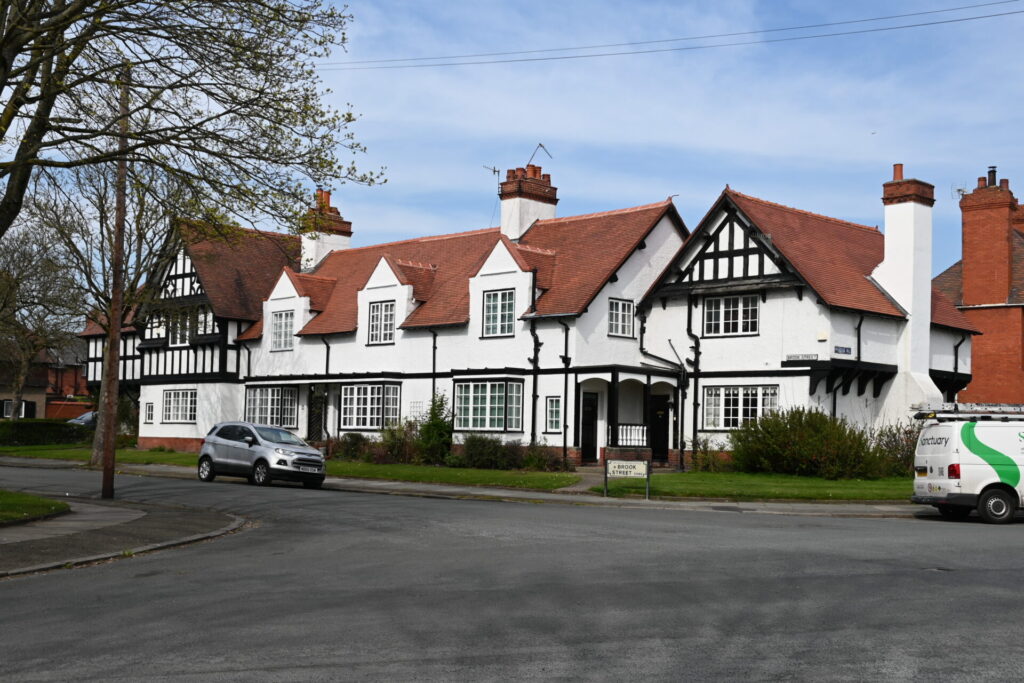
Our first stop iwas Port Sunlight, the planned community developed by William Hesketh Lever who founded the Sunlight Soap brand, now part of the multi-national Unilever company. The town contains 900 Grade II listed buildings in 130 acres of parkland. When completed in 1914 it housed the 3500 workers at Sunlight Works, the soap factory built by William Lever to replace his original factory in Warrington. The work started in 1888 and over the course of its development Lever employed 30 different architects, with consequent differences in style; although all the houses retain an arts and crafts, albeit slightly whimsical neo-vernacular character. The town is a prime example of the ‘garden city’ or suburb, other examples being Letchworth, Bournville and New Earswick. He also provided the town with a school, a cottage hospital, a concert hall, a church and an open-air swimming pool. Our collective feeling was that a factory worker and his family in the late 19th Century, finding themselves in this utopian environment, would have felt the equivalent of lottery winners.




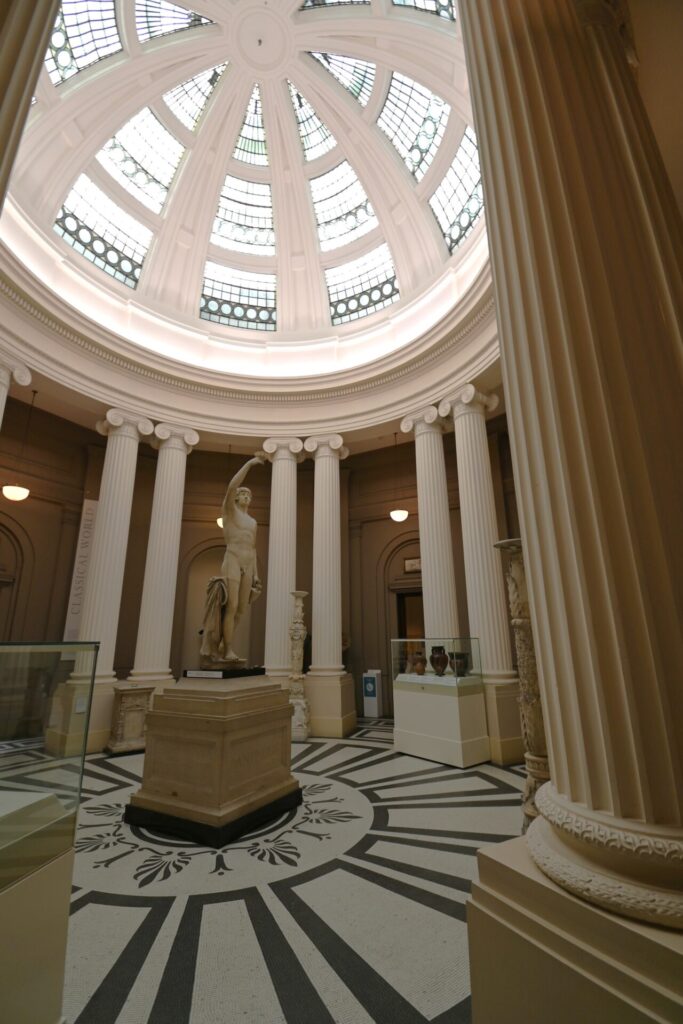
We spent some time at the Lady Lever Art Gallery, built by William Lever in memory of his late wife and to house his collection of paintings, sculptures and ceramics. Opened in 1922 the design is by William and Segar Owen in a style described as Beaux Arts, although to me it is fairly typical of Edwardian swagger. The gallery contains an extensive collection of Pre Raphaelite work by Millais, Holman Hunt, Rosetti, Ford Maddox Brown and Burne-Jones. We also enjoyed works by Turner, Constable, Gainsborough and Reynolds and an extensive collection of Wedgewood pottery. A further point of interest were the art works acquired by Sir William Lever that subsequently were used in the advertising and packaging materials for Sunlight Soap, notably 'Bubbles' the boy with his clay pipe blowing soap bubbles and a scene from a Welsh parlour.


Ferry 'Cross the Mersey
From Port Sunlight our coach took us to the Mersey Ferry Terminal in Birkenhead for a ferry trip across the Mersey; the weather permitted great views of the Liverpool skyline and the ‘Three Graces’, The Royal Albert Dock, The Anglican Cathedral and other landmarks.
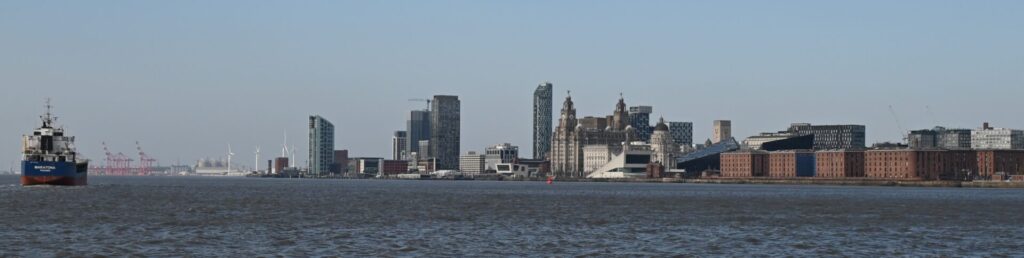


Manhattan on the River Mersey and Bramley Dock, New Home of Everton Football club
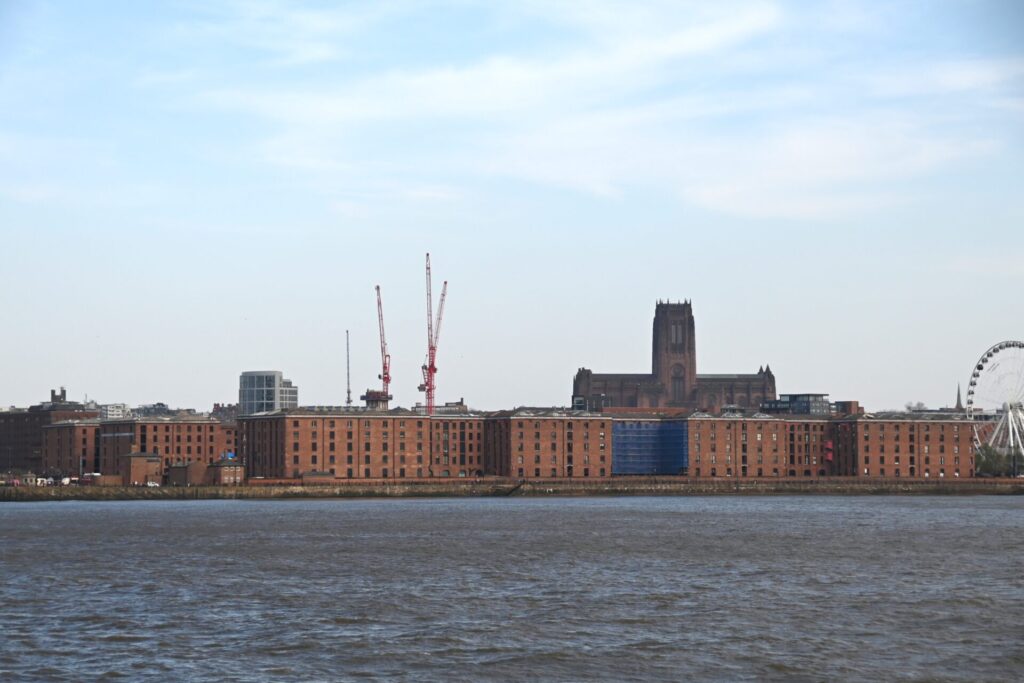

The Royal Albert Dock with the Anglican Cathedral Beyond. The 'Three Graces' (the Liver Building, Cunard Building, and Port of Liverpool Building)
At the Pierhead, we were met by our coach and taken to our hotel, of which, more later.....
Day 2 - Liverpool City Centre and the Cathedrals
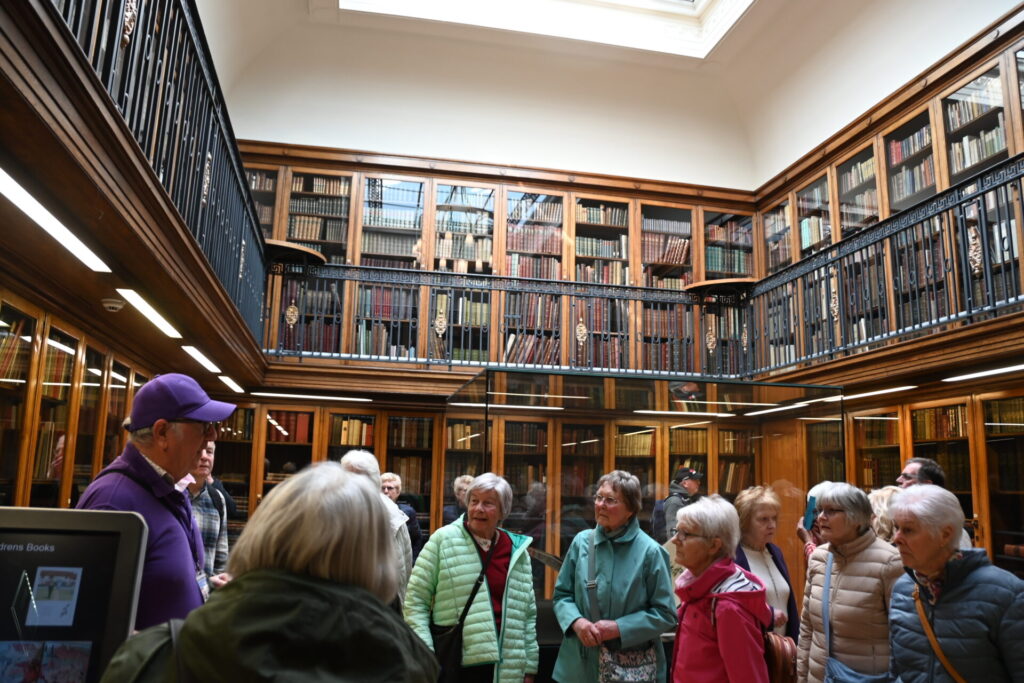
We began our second day with a transfer from our hotel to the city centre where we alighted outside the City Library, where we met Peter, our guide. We began with a surprise by going into the library though its rather unobtrusive entrance in a corner of the very impressive neo classical facade; once inside we were confronted by a breathtaking oval atrium four stories high, in steel, glass and white concrete which is surmounted by a glazed rooflight flooding the space with sunlight. We ascended an escalator to enter a secure room containing many rare volumes including, in a glass case, an original Audubon book of American wild birds. This was followed by a passage through the original Victorian circular reading room complete with wrought iron balconies and spiral staircases.




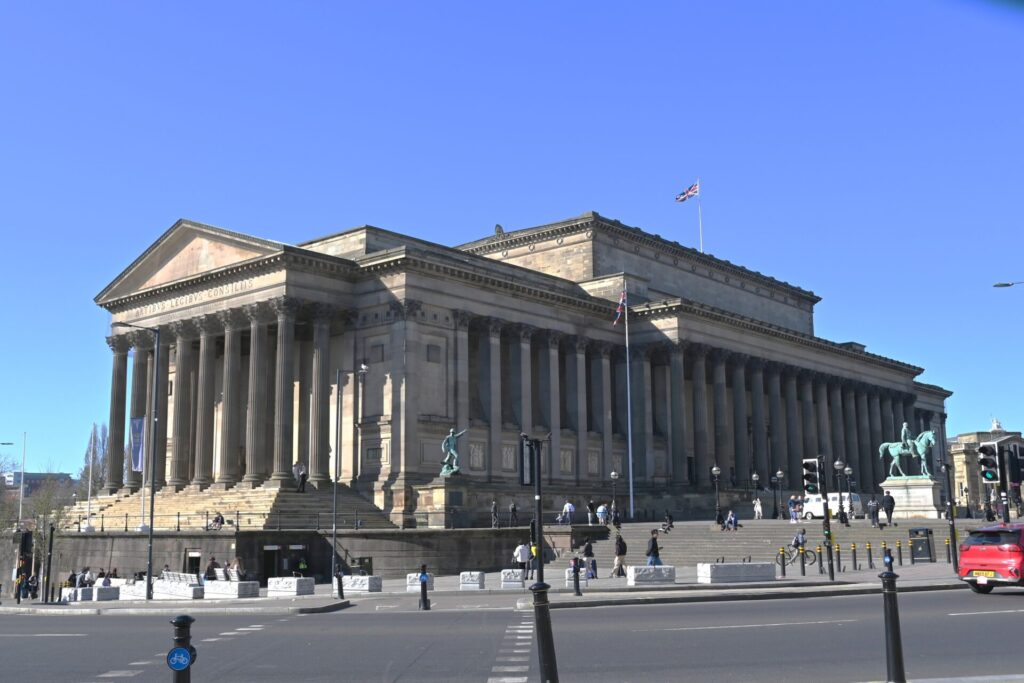
After leaving the Library we passed the collection of splendid neo classical buildings grouped around William Brown Street which include the Library, the World Museum, the Walker Art Gallery and St. George's Hall. St. George’s Hall is a significant building originally financed by public subscription to house music concerts and public events, it also contains courtrooms and ancillary facilities. Its design was the subject of a competition in 1839 won by a 25 year old architect from London, Harvey Lonsdale Elmes; after Elmes' death Charles Cockerell (Ashmolean Museum, Oxford) was appointed in 1851 to complete the project so the interiors are largely his work. The style of the building is neo classical Greek, Nicholas Pevsner described it as ‘the finest Neo-Grecian building in the world’ and it is now listed Grade I. The building’s original construction incorporated a sophisticated heating and ventilation system and in 2005 the Chartered Institute of Building Services Engineers awarded the building a blue plaque recognising it as the world’s first air-conditioned building.


Our walking tour continued past the listed facade of Lime Steet Station and on into the shopping area and 'Cavern Quarter' past the Royal court and Playhouse theatres (and for football fans, the Liverpool FC shop).


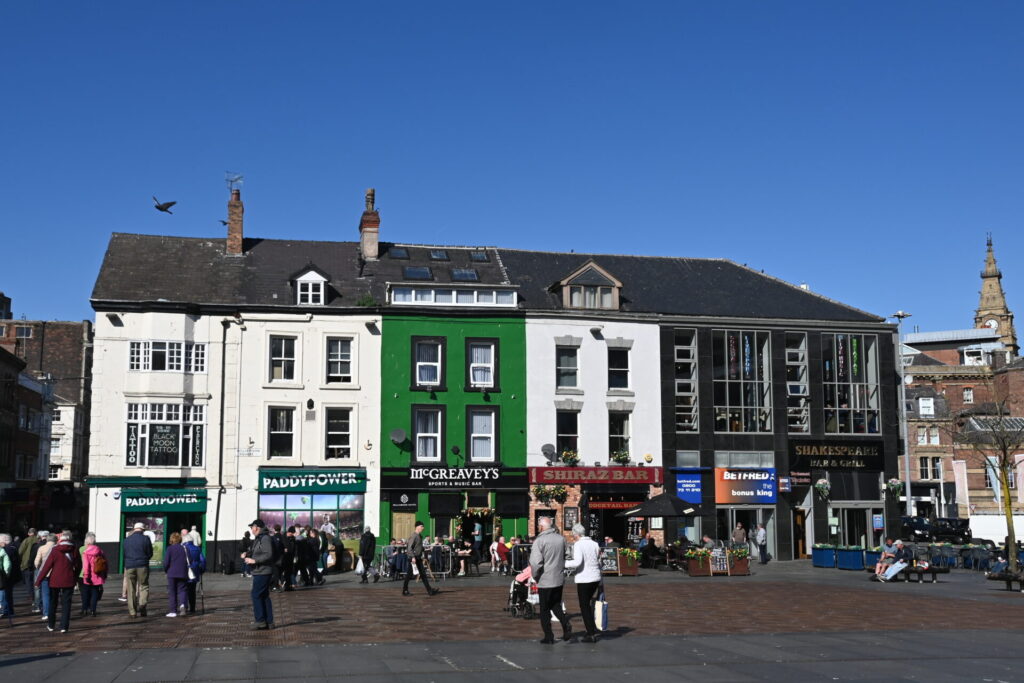


Our walking tour concluded at the Pierhead alongside the 'Three Graces' and the new(ish) Museum of Liverpool.
Hope Street and the Cathedrals
After lunch members has a choice to make; for those interested our coach took us up to the Anglican Cathedral so that a visit to the Cathedral could be followed by a gentle walk down Hope Street to the Catholic Cathedral at its opposite end.
The Anglican Cathedral: Despite its gothic appearance the church was designed by Giles Gilbert Scott (Son of Sir George and also designer of the K2 telephone kiosk) in 1904. The construction which contains steel and concrete, lasted 74 years and was not finished until 1978. It is the largest religious building in Britain and the eighth or fifth largest in the world, depending how you measure it. When he won the competition Giles Gilbert Scott was still only an articled pupil in the office of one of the other entrants; there was further controversy when it was discovered that he was a Roman Catholic, although the church authorities retained him as their architect.


Despite the size and its enormous windows, the dark reddish-brown sandstone internal finish ensures the Cathedral interior remains relatively dark, despite a beautifully sunny afternoon when we visited. However, the sheer scale of the interior space cannot fail to impress. Our visit was enhanced by the presence of an installation called 'Helios' consisting of a huge suspended model of the Sun, then again when, at the suggestion of some of our colleagues, we took the steps to a gallery over the Lady Chapel (larger than many parish churches) to listen to the Choir rehearsing. We thought it was heavenly, although the choirmaster clearly thought it was not heavenly enough!


After our tour of the Cathedral we made our way down Hope Street, regarded by some as the most handsome street in England, (not to be repeated in front of anyone from Newcastle who will vigourously, and with some justification, defend Grey Street) it does contain a very high concentration of listed buildings. The street defines the south west side of Liverpool's Georgian area and as you begin the descent on the right is a terrace of elegant late Georgian or early Victorian houses, opposite them is the Liverpool Institute of the Performing Arts (LIPA) which has incorporated the Liverpool School of Art into it's complex. Next to the Institute the pavement widens and there is a sculpture called 'Case Histories' which consists of a stack of suitcases cast in concrete each one bearing a label with the name of a person with local connections who has made a significant contribution to politics, culture or the arts. To our left was Unity Place, with the modern facade of the Unity Theatre clearly visible amongst the traditional brick frontages.


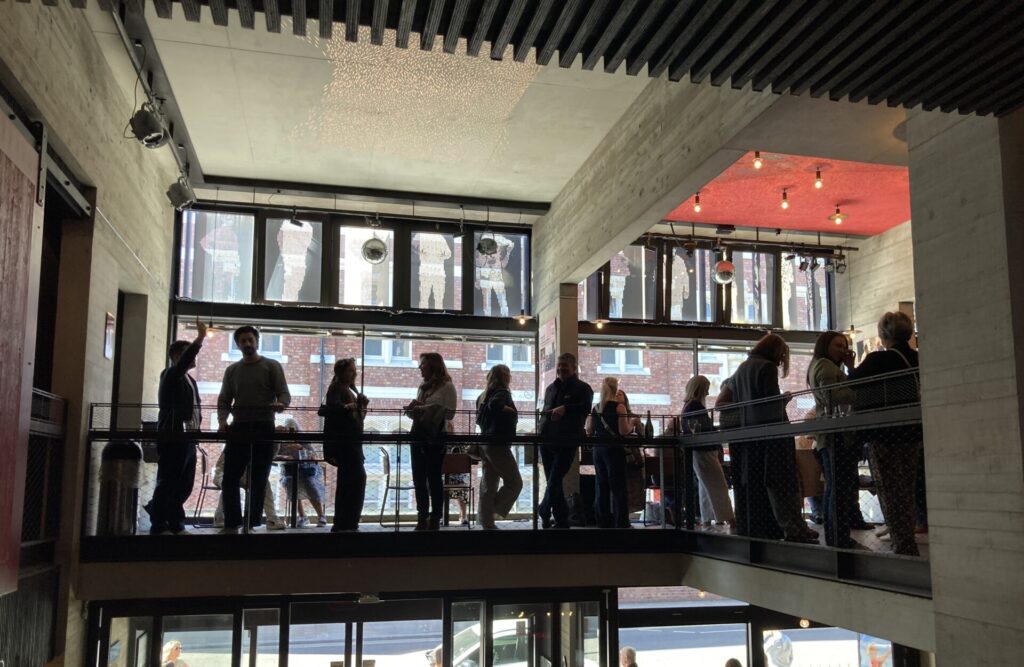
Moving further down the street we came to a cross road which had on its opposite side the Art Deco form of the Liverpool Philharmonic Hall and diagonally across the junction was the Edwardian exuberance of the Philharmonic Dining Rooms. Further on and just before the junction with Mount Pleasant and the Catholic Cathedral was the Everyman Theatre, where we stopped for refreshment. It was newly built in 2014 by the architects Haworth Tompkins on the site of the original Everyman Theatre which was housed in a former chapel. It won the RIBA’s Stirling Prize for Architecture that year. It is naturally (passively) ventilated, relies on minimal heating and cooling, this is evidenced by the four large exhausts, like ships funnels, at roof level. The sunshading on the west elevation comprises 105 aluminium panels each carrying a laser etched photograph of a Liverpudlian, each one selected at random to collectively represent a complete cross section of the Liverpool population, so the facade is a literal interpretation of ‘Everyman’. Our tea break coincided with the interval in an anniversary production of 'Shirley Valentine' which provided the image below of theatre-goers silhouetted against the windows of the first floor bar.


Suitably refreshed we crossed the road to the Catholic Cathedral, better known as the Metropolitan Cathedral of Christ the King, also known, less reverentially, as ‘Paddy’s Wigwam’ and the subject of the line in a famous Liverpool Song ‘If you want a Cathedral we’ve got one to spare’. After an earlier design by Sir Edwin Lutyens was abandoned in the face of escalating costs, in 1959 an international competition held for a new design was won by Frederick Gibberd (architect of Harlow New Town); construction began in 1962 and was completed in 1967. The building sits on one end of the ‘roof’ of Lutyens' crypt and employs a circular plan to enable the congregation of 2000 each to have a direct line of sight to the centrally placed altar. The form of the building is a truncated cone with the roof supported by raking columns radiating outwards, which support a cylindrical lantern. Side chapels are situated between the feet of the columns. The lantern is glazed with stained glass designed by John Piper and Patrick Reyntiens in three colours, red, yellow and blue, to represent the Holy Trinity. Light shines through the lantern down onto the baldachino over the altar designed by Gibberd as a crown-like structure formed from aluminium rods, which also supports lighting and sound equipment. The building, in its unashamed modernity, is a complete contrast to the Anglican Cathedral.


With time now pressing we made our way back down Mount Pleasant to the city centre to our coach rendezvous that provided a final look at the magnificence of St. George's Hall.
While many of us opted for the Cathedrals and Hope Street at least two of the more intrepid members ascended the Liver Building to its 15th floor viewing platform. This guided tour of Liverpool's most iconic building gave them a spectacular 360 degree views of the city plus an immersive audio/visual show in a clock tower and a full history of the landmark including the world famous Liver birds 'Bella' & 'Bertie'.The building was designed in 1908 by Walter Thomas for the Royal Liver Insurance Company - 1st multi-storey reinforced concrete & steel building in the world, used as a template for New York skyscrapers with a granite exterior as decorative cladding. The Liver Birds were designed by largely forgotten German sculptor Carl Bartels. Similarly, the "Great George Liver Clocks" by Gent & Company are the largest electronically driven clocks in the UK with 25 ft diameter faces - named because they were activated on 22/6/1911 at 1:40 pm, the precise moment of King George V’s Coronation. The immersive experience was projected onto the internal walls of the West clock tower & covered the history of Liverpool


Text and Photographs: K.+S. H.
Day 2 - Bonus: Our Hotel
Our Hotel for the Liverpool stay was the Crowne Plaza John Lennon Airport Hotel, it was formerly the passenger terminal for the original Speke Airport and is listed grade II. Its former use was verified by one of our members who remembered making her first flight from here. The building is a splendid example of Art Deco or 'Moderne' design and the bedroom extensions on the 'landside' have been designed with great respect to the original. The modern airport has moved about a mile to the south (so no disturbance from aircraft noise) but the former apron on what was the 'airside' of the buildings contains several vintage aircraft in various states of restoration.


Day 3 - The Walker Art Gallery, the Beatles and Speke Hall

We travelled from our hotel to the Walker Art Gallery in the City Centre, the gallery was built in 1877 to house Liverpool’s growing art collection which was established in 1819. It is named after its principal benefactor, Sir Andrew Barclay Walker a brewer and former mayor of the city and was designed by local architects Cornelius Sherlock and H.H. Vale in a neo-classical style. The gallery was extended in 1884 and again in 1933 and had a major refurbishment in the early 2020’s, reopening in 2022. The collection which is the largest in the UK outside of London consists of Italian and Dutch Masters from 1300-1550, European Art from 1550 to 1900 including works by Rembrandt, Poussin and Degas, 18th and 19th Century British Art including several Pre-Raphaelites and 20th century British art including works by Freud, Hockney, Gilbert and George and a Banksy. Members enjoyed their morning here with particular enthusiasm for the galleries dedicated to the Impressionists and 20th Century British Art, although the gallery containing winners of the Moore's Painting Prize did prompt some consternation.

The Beatles Tour: On the Sunday afternoon of the A&A trip to Liverpool seven of us played truant from the programme, we had booked ourselves on a minibus tour of the childhood homes of Paul and John. The National Trust was gifted the house John was brought up in from the age of 5 until 1963 by Yoko Ono, who purchased it from the person who owned it after John`s Aunty Mimi moved away. Paul lived in six different houses while he grew up but it was in this house that the group which became the Beatles began its existence, and is now owned by The National Trust.

Pictures of Paul McCartney and john Lennon courtesy of Wikipedia/United Press International.
John`s Home. It was pleasant house with a glass porch on the front which, because of the echo, was where John often played his guitar. John had come to this house at 5 years old when his mother, Julia passed him over to the care of his Aunty Mimi and she and her husband George brought him up. The house had a back garden looked on to the large grounds of a house called Strawberry Fields. John used to climb over the wall and enjoyed the large space where he was happily trespassing. I wonder what the owner felt when the song appeared on one of the Beatles’ records
Paul`s Home. Was a three bedroomed terraced house which became the place the young men who became the Beatles practised and where Paul and John wrote their first songs. The piano in the sitting room is the one all the McCartney family played. Paul did once have four music lessons but decided not to continue Mike, Paul`s younger brother has restored the house to look as it did when they all lived there. Mike’s photographs which adorn the walls tell the story of a house full music, and although it was a small house this is where the group of young men, three of whom became some of the most famous people in the world gathered to practise. Mike has made sure the house resembles the home he and Paul remember is true to that memory.
Text: I.M.

Paul McCartney's Childhood Home: Photo Courtesy of The National Trust

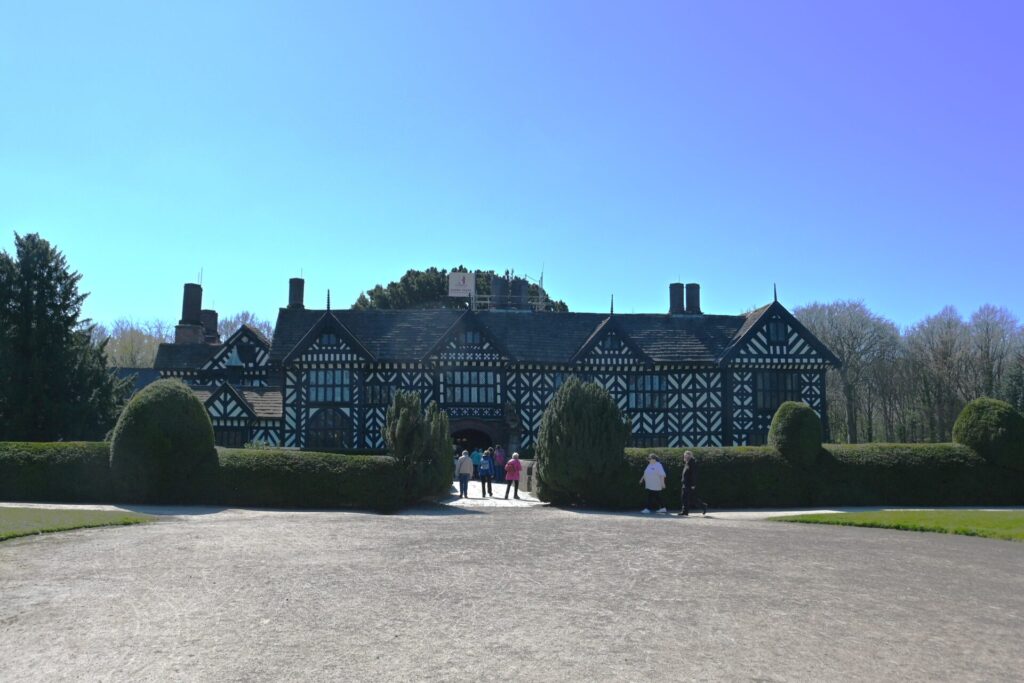
Speke Hall. It is a Tudor mansion on the banks of the Mersey, a splendid half-timbered building, begun in 1530 and completed in 1598, it was restored during the 1800’s with interiors given an arts and crafts makeover with original Morris and Co. wallpapers. Members enjoyed the building, its tudor interiors and extensive grounds with gardens and a maze which were seen in perfect weather. The building and grounds are in the care of the National Trust.

Day 4 - Crosby and Rufford
Our last day started with a journey across Liverpool to its northern extremity at Crosby which gave us an opportunity for a final look at some of the notable places we had visited in the previous two days. Crosby is home to the installation called 'Another Place' by the sculptor Anthony Gormley; it is a series of life size sculptures of the male human form famously, like many of Gormley's works, based on his own body which are placed over a 2 kilometre stretch of Crosby's beach. The tide was almost exactly half way between high and low tides so that some of the sculptures were almost submerged, some still completely visible and others at points in between the two.


From Crosby we travelled to Rufford near Preston to Rufford Old Hall, this is a National Trust property with extensive grounds, gardens and a canal side walk. The Hall has two parts, a timber framed Tudor 'Great Hall' and a later Jacobean residential wing built in brick. The Great Hall was most impressive with a hammer beamed roof having a lantern casting daylight into the centre of the room and an ornate carved screen in bog oak. A short walk took us to Rufford Parish Church with some interesting stained glass. The gardens contained topiaried shrubs, two in the form of squirrels. A fitting close to a stimulating weekend with just a smooth ride back to Bishop Auckland and chance to rest tired legs and feet to follow!


