On 27th November the group gathered at the Methodist Church Hall to view two films in the 'Power of Art' series, dramatised documentaries on the lives of significant artists. The films selected were on JMW Turner and Pablo Picasso.
The 32 members of the Art & Architecture group members who attended this showing greatly enjoyed comparing and contrasting these two eminent painters.
I personally had always thought that Joseph Mallard William Turner was a Regency painter whose paintings, while truly magnificent, revealed a painter, similar to Renoir, who was in need of spectacles while Pablo Picasso, equally gifted, tended to enjoy teasing his viewers rather than utilising his undoubted skills to their full potential.
How wrong I was!
We were told that while Turner, borne close to Covent Garden by a mother who died in a lunatic asylum, had sought to maintain a lower-class accent and avoid the trappings of his success and fame. He never married yet had two daughters, acquired a fashionable house and relied upon his father to manage his business affairs. Picasso however thrived upon publicity, sustained a thriving and varied personal life, led the cubist and other early 20 century movements, and remained in the vanguard of modern art throughout the twentieth century. But the theme of the DVDs was how they both found themselves unexpectedly involved in the politics of their age.
In Turner’s case, his long commitment to challenge the slave trade led to his famous 1840 painting The Slave Ship, being poorly received when displayed in the Royal Academy. The Fighting Temeraire the previous year had pleased the critics, as had his earlier marine and landscape paintings. The Slave Ship was too close for comfort: it drew attention to the then insurance arrangements for slave ships – slaves lost at sea were covered, slaves dead on arrival were not covered. Look at the bodies in the sea.
Picasso’s success in Paris throughout the first two decades of the twentieth century was phenomenal, but from the early 1930s his growing interest in the country of his birth led his back to Spain and to his major work, Guernica. Guernica was a small Basque town of c8000 residents but, out of the blue and for no apparent military reason, was heavily bombed by Italian and German bombers supporting General Franco. Deaths and casualties were significant. Picasso was drawn to create the painting for the Spanish Pavilion at the Paris International Exposition, 1937. Aspects of the painting were explained. Features never previously appreciated were highlighted. We were all intellectually and emotionally exhausted! We were then told that when Picasso was living in Paris in 1941, a German officer came to his studio and saw a postcard of Guernica and asked if he did it. To which he replied, “No, you did it!”
CH 28.11.26

JMW Turner -The Slave Ship
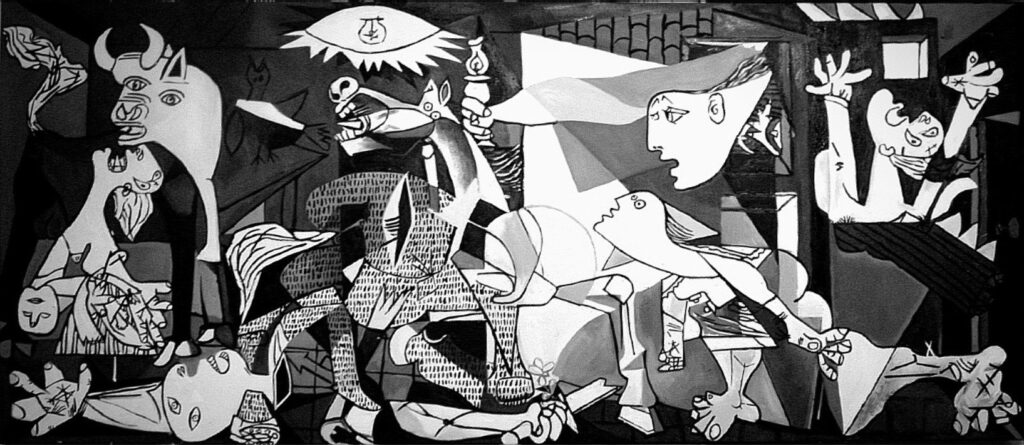
Pablo Picasso - Guernica